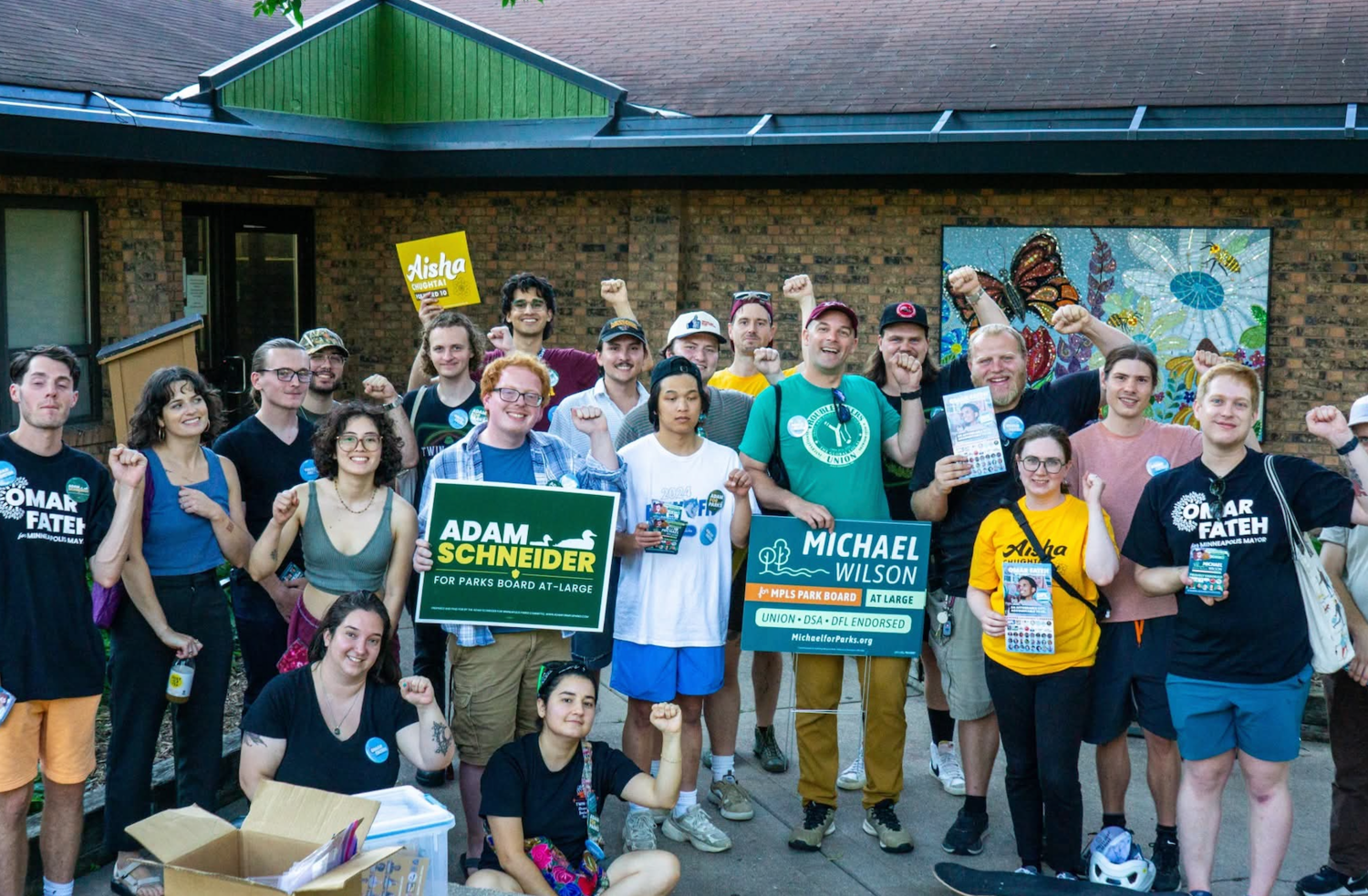


One of the busiest groups during last year’s city election was the Twin Cities Democratic Socialists of America.
Since its official registration in 2017, the group has grown in membership and political influence in Minneapolis. It established a political education committee in 2019, and, in 2021, it endorsed and campaigned for four candidates for the Minneapolis municipal election. Three of those candidates were elected to the City Council.
In 2025, the Twin Cities DSA organized thousands of volunteers to campaign in Minneapolis for seven endorsed candidates: Omar Fateh for mayor; Robin Wonsley, Soren Stevenson, Jason Chavez, and Aisha Chughtai for City Council; and Adam Schneider and Michael Wilson for Minneapolis Park and Recreation Board.
All four of the DSA City Council candidates won election.
Chughtai and Wonsley were subsequently elected to the City Council’s leadership team as majority and minority leader respectively.
Wonsley, who ran as an independent with Twin Cities DSA endorsement in 2021 was attracted to it as part of a larger democratic socialist movement.
“I’ve always wondered what alternatives could replace the system that has not fared Black people and working class people in general well,” said Wonsley.
MAKING A DIFFERENCE
Longfellow neighborhood resident Tim Hart has been a Twin Cities DSA member since 2020, and is now one of the group’s two co-chairs.
“I was attracted to democratic socialism in 2015 with Bernie Sander’s run for president,” Hart said. “After that, two things brought my attention to DSA. (Alexandria Ocasio-Cortez's) election in 2018, and a small event in a North Texas chapter called a brake light clinic.
DSA members would replace people’s brake lights for free so that police couldn’t use that as a pretext to pull them over, while providing educational materials about police reform and abolition.”
Hart said he joined the Twin Cities DSA during the COVID-19 pandemic because it was involved in both politics and helping people on the ground.
“It’s the organization I joined where I thought I could help make a difference,” Hart said.
RESPONSE TO ICE
Mutual aid, environmental justice and workers’ rights are all part of the group’s work.
“Most of the mutual aid work has been focused on the distribution of food and supplies to homeless encampments,” said Hart. For the past two months their attention has also turned to helping respond to federal law enforcement activity.
“Most of our work now is focused on how we operate and respond to the current occupation,” said Hart, noting that members are “very engaged.”
The Twin Cities DSA has developed their own legal observing training and hosted one on Feb. 7 at the First Unitarian Society of Minneapolis in Lowry Hill. Volunteers have also been canvassing local businesses sharing information on their rights related to the U.S. ICE and Border Patrol activities.
“I think TCDSA is key to responding to the ongoing attacks from the federal government,” Schneider said, who remains an active member of the group following his unsuccessful bid for the Minneapolis Park & Recreation Board. “They’ve been key to mutual aid and rapid response efforts, and, without them, community resistance would not only be disorganized, but potentially more dangerous and less helpful.”
REDISTRIBUTION OF WEALTH AND POWER
Schneider lives in the East Bde Maka Ska neighborhood and also works in the area as the Greening & Development Coordinator for the Stevens Square Community Organization.
“I sought TCDSA endorsement because I am a democratic socialist. I believe we need a redistribution of wealth and power through democratic means, including elections, but also workplace democracy, such as via unions and cooperatives,” Schneider said. “I was proud to be endorsed by the Green Party, Twin Cities DSA, many local DFLers, and other progressive organizations and organizers.”
Some voters expressed concern about the socialist label. “More than once, I’ve had someone respond to an email or text blast with something along the lines of ‘I like what you have to say, but I can’t support a radical socialist,’” recalled Schneider.
“People and institutions that benefit from the unjust status quo try to stoke Red Scare-style fears about socialism,” said Wonsley. “Even though socialist policies like reducing U.S. imperialism and military spending in order to ensure all working people have living wages, universal childcare, single-payer healthcare, are broadly popular.”
Nonprofit, not party
According to Hart, the Twin Cities DSA is an all-volunteer, membership-based, non-profit organization affiliated with the national Democratic Socialists of America organization. Neither the local nor the national umbrella organizations are political parties.
Since its founding in 2017, it has been registered as a 501(c)(4) tax-exempt non-profit in Minnesota. By law it is considered a “social welfare organization” that is committed to promoting the common good and general welfare of the community.
Unlike 501(c)(3) charitable nonprofits, they can engage in lobbying and in political campaigns and endorse candidates so long as that doesn’t make up the majority of their activities. Donations to 501(c)(4)s are not tax-deductible.
Thousands of entities, including the Minnesota Rifle & Revolver Association, American Civil Liberties Union of Minnesota, and Sierra Club North Star Chapter, for example, share a similar structure with affiliated national organizations, 501(c)(4) status and registered political funds.
The Twin Cities DSA is a local chapter of the national DSA. It is chartered with them and partners with them on various electoral and non-electoral campaigns. As a local chapter its membership dues are collected by the national office and redistributed to the local chapter after a portion is kept to cover costs and provide technical assistance.
The Twin Cities chapter includes 14 Minnesota counties in the greater metropolitan area and two counties in Wisconsin. Hart said the Twin Cities chapter has about 2,200 members.
TWO-PARTY SYSTEM ‘ISN’T SERVING ORDINARY PEOPLE’
“There’s an active discussion within the DSA about strategy around becoming a political party,” said Wonsley. “But we’re all united in understanding that our current two-party system isn’t serving ordinary people and a commitment to building working class political power in the long-term to build a better world for all.”
While the Twin Cities DSA is not a political party, a political action committee, or an independent expenditure political committee, it has registered a political fund with the Minnesota Campaign Finance Board.
According to their 2025 year-end filing, the organization spent $5,132 on electoral activities last year, with roughly half of that going to the campaign committees of the candidates they supported.
Organize Organize Organize
In the 2025 election the Twin Cities DSA hosted over 1,000 door knocking shifts and knocked on over 50,000 doors.
“Overall, the TCDSA endorsement was a boon to my campaign,” Schneider said. “It was amazing to be part of a slate of transformational candidates, and it was great to support each other while on the campaign trail.”
“From neighborhood mutual aid to local and national elections,” said Wonsley. “We have more power than the billionaires – but only if we organize.”
Hart sees all the campaigns, whether electoral or not, as a way to help people be better organizers and gain skills that can serve them in making positive changes in and beyond the DSA.
“I am most proud of creating organizers,” Hart said, which is done not only through formal training but also by giving people opportunities to table, door knock, talk and build relationships.
The Twin Cities DSA’s greatest strength, he believes, can be found in the breadth of its work and how it “builds connections between movements that are too often segmented.”
Wonsley sees Twin Cities DSA as part of a larger democratic socialist movement and said that its greatest strength is its “clear vision and plan for a world where all working class people can thrive.”
The Twin Cities DSA recently moved its office from St. Paul to Minneapolis, into the historic Coliseum Building on East Lake Street.
Their annual convention will be held on Feb. 28 in South Minneapolis at the Eagles Club in Seward, where they plan to elect chapter leaders, and discuss their platform, bylaws and priorities for the coming year.



Comments
No comments on this item Please log in to comment by clicking here